
Start With the Match Format: BO1, BO3 or BO5
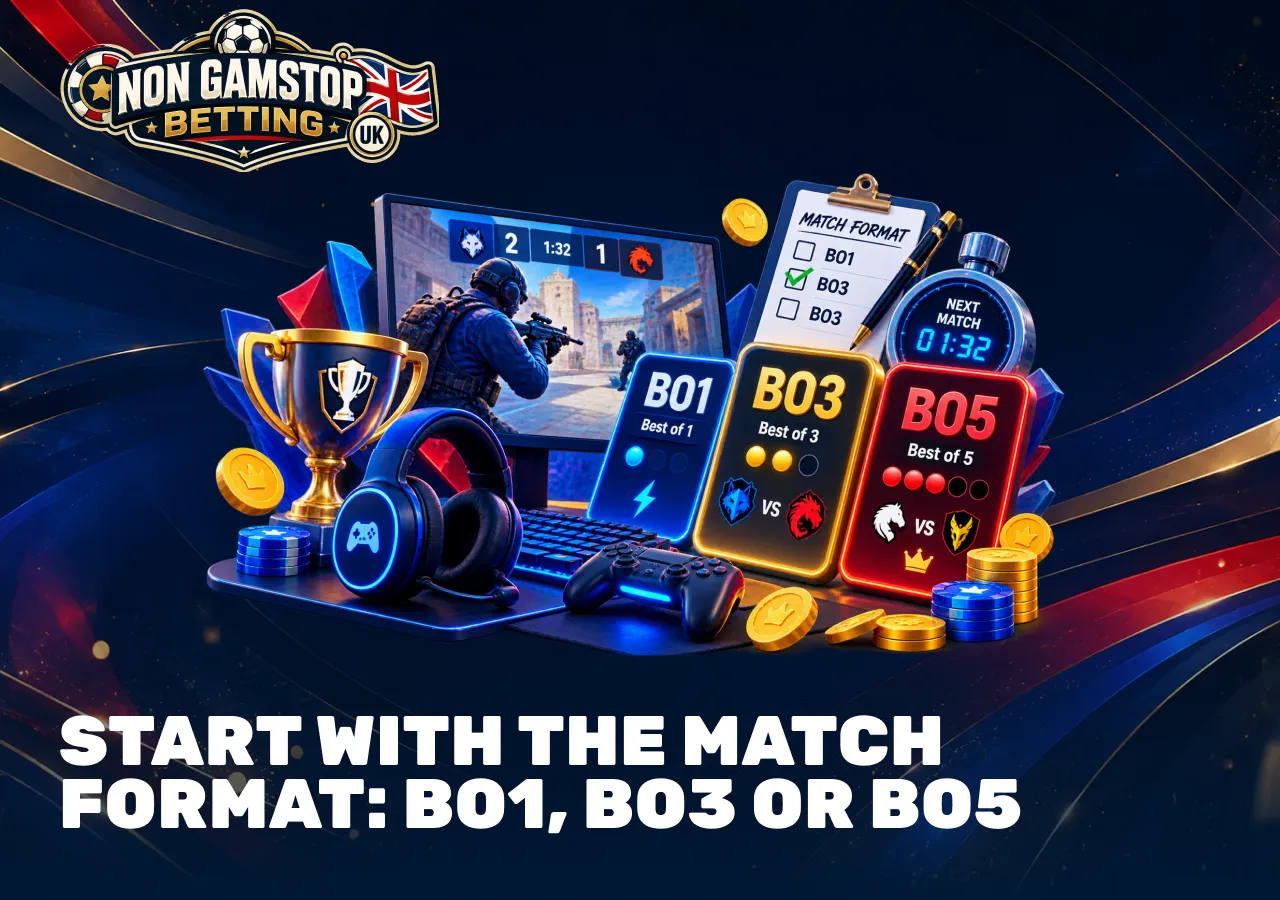
Match format changes the meaning of an esports bet.
A BO1 is decided in one map or game. A BO3 requires two wins, while a BO5 normally requires three.
This affects the available markets and the way the overall match price behaves. One weak map ends a BO1 immediately, whereas a team can lose the opening map of a BO3 and still win the series.
Match Winner and Map Winner
The overall match winner covers the full series.
A map-winner market applies only to the named map. A team can therefore lose Map 1 and still win the match 2–1.
The distinction needs to remain visible right through to the bet slip. On a crowded esports interface, “Team A to Win” is not enough if the user cannot immediately see whether the selection refers to Map 2 or the full series.
Map Veto and Scheduled Maps
Map selection can affect the matchup before the first round begins.
In titles where teams pick and remove maps, the eventual map pool can influence individual map prices. The sportsbook does not need to provide tactical analysis, but it should clearly identify which map a market refers to once that information is known.
A late map change can also affect settlement, particularly when map-specific markets have already been opened.
Correct Series Score and Total Maps
Longer formats support exact series-score and total-map markets.
In a BO3, a correct-series selection might distinguish between 2–0 and 2–1. Total maps instead asks whether the series reaches its final possible map.
Both markets depend entirely on the match format, so BO3 or BO5 status should remain visible rather than being buried on the tournament page.
Four Games, Four Different Betting Structures
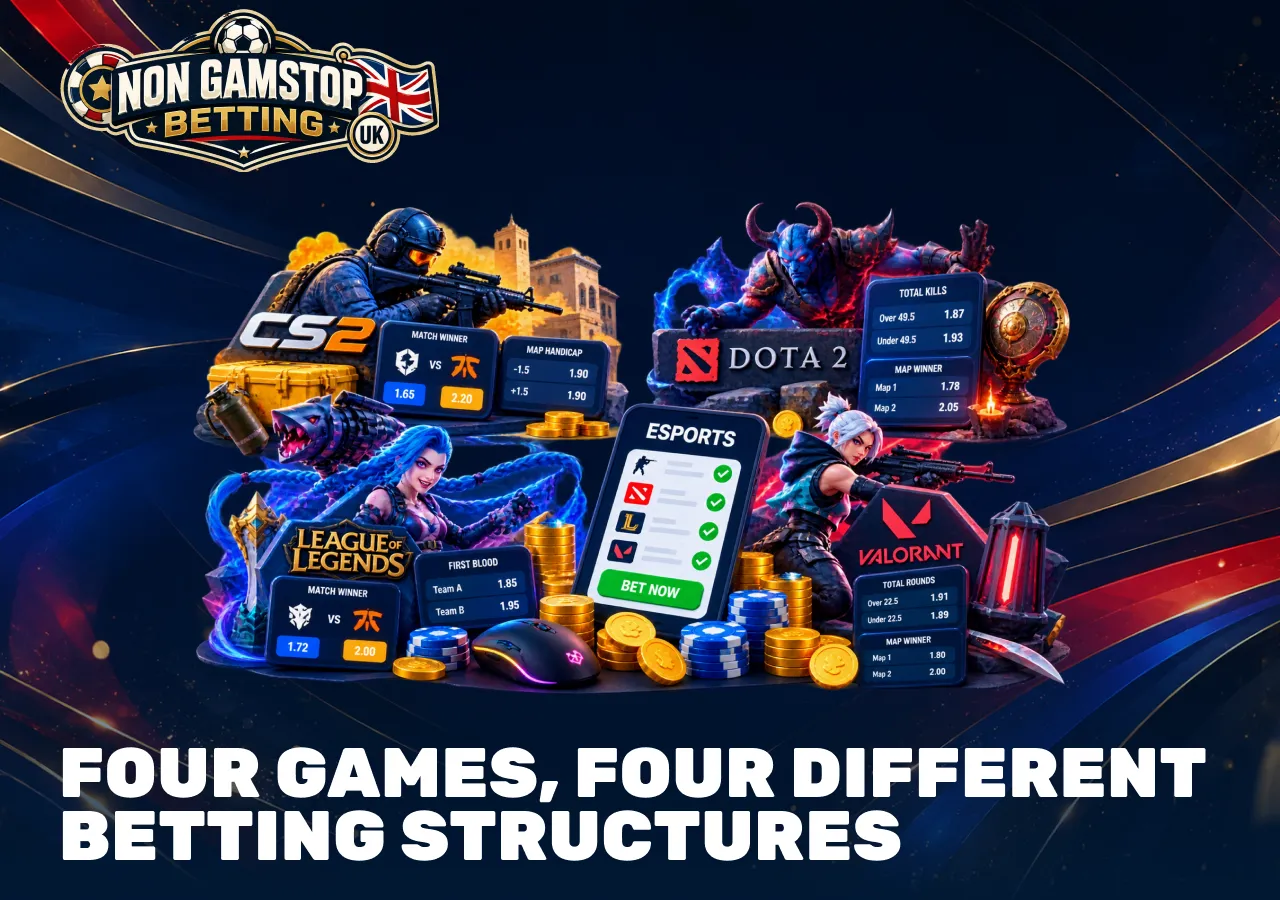
Esports is a collection of competitive games with very different match structures.
A CS2 series is built around maps and rounds, League of Legends and Dota 2 revolve around objectives and team fights, while Valorant combines tactical rounds with character abilities.
That difference directly affects which betting markets are relevant and how quickly live prices can move.
Counter-Strike 2
Counter-Strike 2 is a team-based tactical shooter played between two five-player sides. One team attacks while the other defends, with sides switching during the map.
Matches are divided into individual rounds, and competitive series commonly use several maps rather than one continuous game.
That structure makes CS2 particularly suited to map and round-based betting. The overall series result only tells part of the story because each map can develop differently depending on the teams, map pool and in-game economy.
CS2 betting is therefore heavily shaped by rounds and individual maps.
Beyond the overall series result, the most game-specific markets can include pistol-round winners, round totals and player kill props.
These are particularly useful for judging whether the sportsbook has built a genuine CS2 section or simply added the match winner.
Roster information matters too. Player markets become difficult to assess if the site does not explain what happens when a named player is replaced or takes no part in the series.
For bettors comparing CS2 coverage, the difference between a basic and a deeper sportsbook often becomes obvious once Map 1, Map 2 and player markets are opened separately.
League of Legends
League of Legends is a five-versus-five multiplayer strategy game in which teams compete to destroy the opponent’s Nexus.
A match develops around lanes, team fights and neutral objectives such as dragons and Baron Nashor.
Unlike a round-based shooter, a LoL map runs continuously until one team wins. This creates betting markets around both the final result and important events that happen during the game.
League of Legends betting therefore has a stronger focus on map objectives.
Depending on the fixture, markets may cover first blood, first tower, first dragon, first Baron and team or total kills.
Those markets are much more characteristic of LoL than a generic match-winner line. They also create additional settlement questions when a map is restarted or an official ruling changes the result.
Series format still matters. A team can lose the opening map of a BO3 and recover over the next two, so match-winner and individual-map betting need to remain clearly separated.
Dota 2
Dota 2 is another five-versus-five multiplayer battle arena game, but its match structure and in-game economy create a different betting environment from League of Legends.
Teams compete to destroy the opposing Ancient while gaining gold, experience and control of the map.
Individual games can change direction quickly after major team fights, buybacks or shifts in map control.
For betting purposes, this makes both the series result and individual map state important.
Dota 2 betting commonly extends into first blood and kill-related markets. Larger fixtures may also provide a wider choice of map-level and team-performance options.
The exact selection varies by tournament and match importance, but a well-structured Dota 2 page should make the current game or map clear before a prop is selected.
Longer series can also create significant differences between the overall match price and the price on a particular map. A favourite losing the first map does not necessarily mean the full-series position has disappeared.
Valorant
Valorant is a five-versus-five tactical shooter built around rounds, attacking and defending sides, and agents with different abilities.
The round structure creates some similarities with CS2, but the use of agent abilities, ultimates and different map strategies gives Valorant its own competitive rhythm.
Matches are normally played as series of maps, which makes the distinction between the overall match and an individual map especially important.
Valorant betting is strongly tied to rounds.
Round handicaps, total rounds and map-specific markets are particularly relevant. During live play, the current round score needs to stay visible because an in-play handicap makes little sense without it.
The difference between a series market and an individual map market should also be obvious on smaller mobile screens.
A deeper Valorant section should therefore make it easy to move between the full-series price and the markets attached to each map without losing track of the current score.
Other Esports Titles
CS2, League of Legends, Dota 2 and Valorant cover several of the main betting formats, but they are not the whole esports market.
Some esports sportsbooks also offer Call of Duty, Rainbow Six Siege, Rocket League, EA Sports FC, StarCraft II and other competitive titles.
Call of Duty and Rainbow Six Siege add more round and map-based shooter markets. Rocket League uses short, continuous matches built around goals, while EA Sports FC resembles football betting more closely in the types of outcomes that can be priced.
StarCraft II is primarily a one-versus-one strategy game, so team-based player props are less relevant.
These extra titles improve the range only when the market structure fits the game itself. Simply adding more game names to the esports menu does not create deeper coverage.
Open One Match Instead of Counting Game Logos
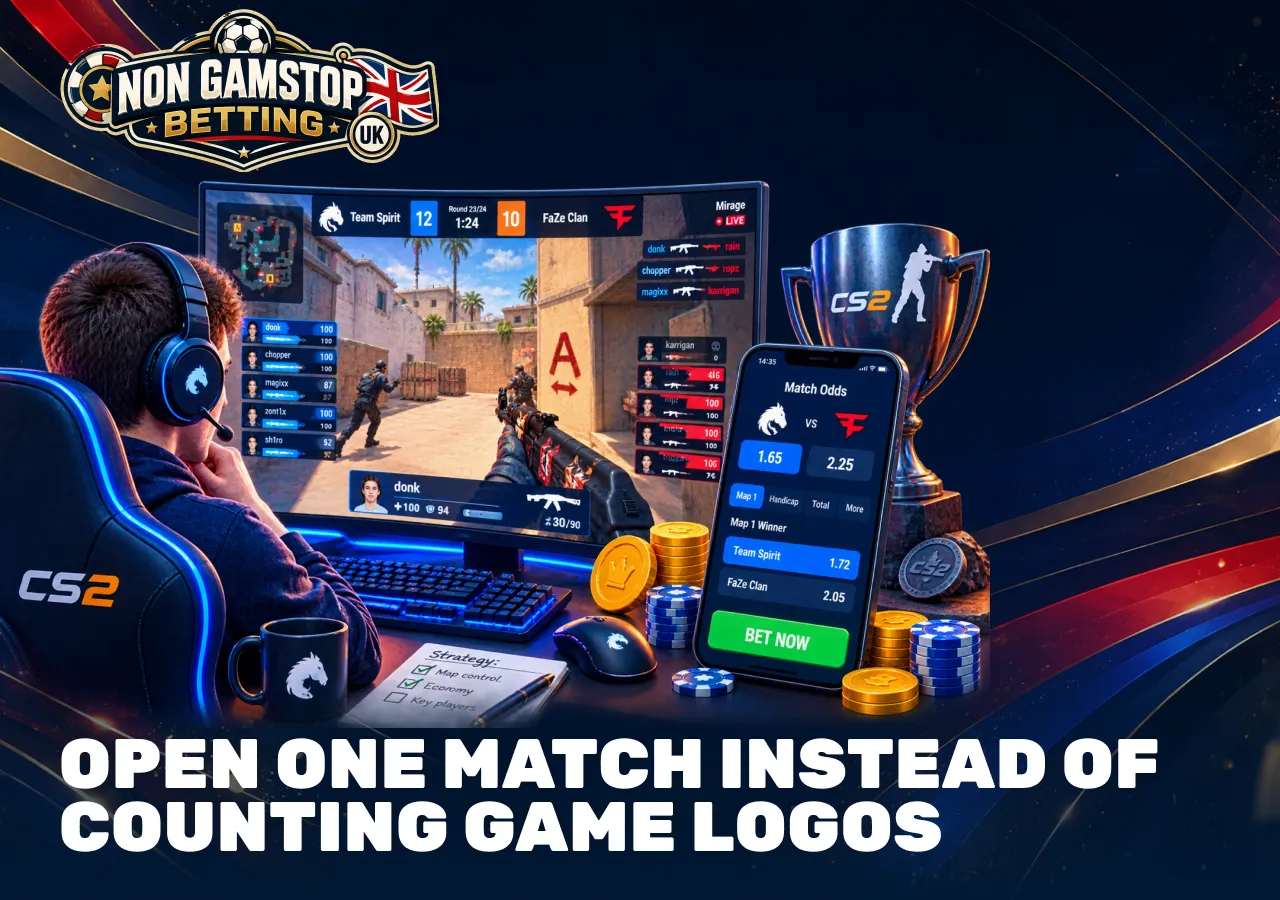
The strongest esports sections do not rely on a long list of game logos.
They make it easy to move from a tournament to a fixture, identify whether the match is BO1, BO3 or BO5 and see which markets apply to the full series and which apply only to a particular map.
For non-GamStop esports betting, market depth also needs to remain consistent outside the biggest events.
A sportsbook may devote considerable space to a CS2 Major or League of Legends Worlds while giving ordinary league fixtures little more than a match-winner price.
Several details quickly separate a deeper product from a basic one:
- regular coverage of the games you actually follow;
- clear series and map labels;
- alternative handicaps and totals;
- game-specific player or objective markets;
- current map and series scores during live betting;
- published rules for forfeits, restarts and roster changes;
- straightforward access to withdrawals and account terms.
A large general sportsbook can still have a thin esports section. The individual match pages usually reveal that faster than the main esports lobby.
How the Comparison Works in Practice
Our comparison applies the same core criteria across the sportsbooks considered for the ranking.
We use comparable CS2, League of Legends and Valorant fixtures to assess the series format shown on the event page, the available map markets, handicaps, totals and game-specific props.
Live coverage is judged separately.
The main points are whether the current map and overall series score remain visible while odds update, how clearly suspended markets are marked and whether series and map bets remain distinguishable during play.
| Test area | What we compare |
| CS2 | Round markets, pistol rounds and player kills |
| League of Legends | Objectives, kills and map-level markets |
| Dota 2 | Map markets, kills and series depth |
| Valorant | Round lines and map pricing |
| Match format | BO1, BO3 or BO5 shown before the bet is placed |
| Live | Map and series score visible with current markets |
| Odds | Identical lines compared at roughly the same time |
| Settlement | Forfeit, restart, walkover and substitution rules |
| Mobile | Clear path from fixture to market and bet slip |
| Account | GBP, withdrawals, KYC and operator details |
A lower-tier qualifier will normally carry fewer markets than a major tournament fixture, so the comparison needs similar events rather than raw market counts taken from unrelated matches.
Markets Built Around Maps, Rounds and Objectives
General esports betting markets can be grouped into several recurring types, even though the details vary by game.
Map and Round Handicaps
A map handicap adjusts the series score for betting purposes.
In a BO3, a favourite at -1.5 maps usually needs a 2–0 result to cover. The opposing team at +1.5 can lose the series 2–1 and still satisfy the handicap.
Round handicaps work inside individual maps in titles such as CS2 and Valorant.
Alternative lines are useful because they give several prices around the same matchup. The exact handicap needs to be considered alongside the odds.
Total Maps and Total Rounds
Total-map markets focus on the length of the series.
A BO3 can finish in two maps or reach a third. Total rounds work within an individual map where the game format supports them.
A bettor needs to know which map and series the total refers to. Similar-looking numbers can represent completely different markets.
Correct Score
Correct-score markets require a more precise prediction.
For a series, that might mean 2–0, 2–1, 3–0 or 3–2 depending on the format.
Some games may also support more granular map-score markets.
The market can be useful, but only when the series format and named event are visible before confirmation.
Player Props, Kills and Objectives
Game-specific props are where esports betting markets become more specialised.
Possible examples include:
- player kills;
- team kills;
- first blood;
- first tower;
- first dragon;
- first Baron;
- pistol-round winner.
Not all titles support the same markets, and lower-profile fixtures can have far fewer props than major events.
That variation is normal. What matters is whether the available props match the game rather than appearing as generic labels copied across every title.
Compare the Bet Before Comparing the Price

Esports betting odds only make sense when the underlying market is identical.
One sportsbook might price a team at 1.90 on a -1.5 map handicap while another offers 1.95 on the outright match winner.
The larger decimal price does not automatically represent better value because the conditions are different.
A fair comparison keeps the following aligned:
- fixture;
- match or map;
- market;
- handicap or total;
- approximate timestamp.
Team news, roster announcements and map information can move esports prices quickly, so timing matters.
A single favourable price tells very little about the sportsbook as a whole.
Comparing the same match winner, one identical handicap and one equivalent map market gives a more representative sample.
The same principle applies to esports bookies not on GamStop and UKGC-licensed sportsbooks alike: a different line is a different bet.
Once the Series Goes Live, Context Matters More
Live esports betting is heavily dependent on match state.
A bettor may need to track the overall series score, current map score and, in a round-based title, the round count at the same time.
A good live interface keeps that context beside the current markets.
When Markets Disappear
Markets can be suspended during important phases of play.
A decisive round, major objective, technical pause or rapid change in the score can cause prices to disappear temporarily and reopen at a different level.
Short suspensions are not unusual.
The interface becomes problematic when a reopened market appears beside an outdated score or unclear map label.
Betting on the Current Map
Once a series starts, users may still want to bet on an individual map rather than the entire match.
Current map winner, round handicap, totals and next-event markets can all appear depending on the title.
Series and map markets should remain visually separate.
During a BO3, an in-play bet on Map 2 is a very different proposition from a bet on the overall winner.
Live Data and Streaming
Some sites provide live streams, visual trackers or statistical feeds.
The useful part is the match-state information they add.
A stream alone does not compensate for unclear markets or poor score labelling.
For live esports betting, current score, map number and open markets remain more important than the presence of a video player.
Edge Cases Are Part of Esports Betting
Settlement rules are particularly important in esports because technical and administrative events can affect a match without producing a normal completed result.
The bettor needs to know what happens before that edge case occurs.
| Situation | What the bettor should verify |
| Forfeit before start | Is the match bet void or settled? |
| Forfeit after Map 1 | Do completed map bets stand? |
| Walkover | What happens to a single bet or accumulator leg? |
| Map restart | Does the original map market remain valid? |
| Cancelled map | Is the map selection void? |
| Player substitution | What happens to named-player props? |
| Roster change | Does the original match market stay open? |
| Administrative DQ | Is settlement based on play or the official ruling? |
These rules can differ between non-GamStop esports bookmakers, so one general assumption should not be carried from one sportsbook to another.
Forfeits and Walkovers
A walkover can allow one team to advance without playing the scheduled fixture.
A forfeit can happen before or after play has begun.
The timing can matter.
A sportsbook may treat the full match, already completed maps and unresolved player props differently.
Accumulators create another question because the affected selection may be voided rather than settled as a normal winner or loser.
Map Restarts and Technical Problems
Server issues and technical failures can produce pauses or complete map restarts.
If the organiser orders the map to be replayed, the sportsbook’s rules determine whether the original map market remains active.
Cancelled maps need similar treatment.
The rule should be clear enough to explain whether settlement follows the first played version, the restarted map or the organiser’s official result.
Roster Changes and Player Substitutions
Player props introduce another layer.
A named player may be withdrawn before the fixture or replaced during the series where tournament rules allow it.
The sportsbook needs a participation rule that explains when a player selection becomes valid and when it is void.
This is particularly relevant to CS2 kill markets and other player-specific props.
Disqualifications and Organiser Decisions
A team can also be disqualified during or after an event.
That does not always resemble an ordinary match loss.
Settlement rules should explain whether later administrative decisions affect bets or whether the result at the end of play is used.
These edge cases make a detailed esports rulebook more valuable than a generic promise to settle bets according to “official results”.
Majors Are Easy; Qualifiers Show the Real Depth
Tournament depth is easier to judge from the individual competition pages than from the size of the tournament menu.
A useful page shows upcoming fixtures, competition stage, game title and match format without forcing the bettor back to the main lobby.
Major events may attract broader markets, but regular leagues and qualifiers reveal how much coverage remains during ordinary weeks.
CS2 can include Majors, ESL and BLAST events.
League of Legends schedules extend through regional leagues, MSI and Worlds.
Dota 2 has its own international and regional events, while Valorant follows the VCT structure and its larger championship events.
Tournament outrights add another type of market by allowing bets on the eventual winner rather than a single match.
For longer-term esports tournament betting, withdrawals, replacements and format changes are worth checking in the settlement rules before the event is completed.
Can You Still Tell Where You Are on Mobile?
Esports creates a specific mobile problem because a single fixture may contain overall series markets, several map tabs, player props and live statistics.
The easiest test is a normal betting path:
game → tournament → match → map market → bet slip
Then repeat it with a player prop.
If moving from Match Winner to Map 2 repeatedly sends the user back to the main esports menu, navigation becomes unnecessarily slow.
The current series score and map score are especially important during live play.
Hiding either one makes an otherwise correct live price harder to interpret.
A native app is not essential. A mobile website can handle esports well if the hierarchy between series, maps and individual props remains clear.
Bonuses Only Matter if Esports Qualifies
A generic sportsbook offer is only relevant here if esports selections actually qualify.
The important details are esports-specific:
- whether map bets qualify;
- whether player props qualify;
- whether live esports bets are allowed;
- whether an accumulator may contain esports selections;
- what happens to a promotional accumulator after a void leg;
- whether tournament-specific odds boosts have separate limits.
Esports free bets can also be tied to individual games or competitions.
A headline bonus is less useful if the markets a CS2 or LoL bettor normally uses are excluded.
Esports Accumulators
An esports accumulator combines several selections into a single bet.
The legs may come from one title or several games.
For promotional use, the sportsbook may set:
- minimum number of legs;
- minimum odds per leg;
- eligible game types;
- excluded player props;
- live-bet restrictions;
- maximum promotional payout.
Forfeits and walkovers deserve particular attention here because a void fixture can alter the number of valid legs.
Account Checks Come After the Esports Product
Payments only need a short check on an esports page.
When comparing non-GamStop esports betting sites, the practical account details are whether GBP is supported, which withdrawal methods are available, the minimum withdrawal and when verification may be requested.
A deposit method does not always support withdrawals.
Some sites may also accept digital currencies, but Bitcoin or USDT support does not make the esports product stronger.
Match depth and settlement rules remain separate questions.
For higher balances, published payout limits and withdrawal conditions are worth reading before funds accumulate in the account.
Licence and Operator Details
Operator information forms a separate part of the review.
Before a sportsbook is considered on its betting features alone, the key details to locate are:
- legal company or operator name;
- stated regulator;
- licence number or reference where provided;
- licensing jurisdiction;
- complaints procedure;
- responsible gambling tools;
- access to betting and account terms.
A licence logo on its own does not establish how an operator is regulated or whether the information shown can be verified.
The company details, regulatory framework and complaints route need to be readable before a large balance is left in the account.
UK Regulation and GAMSTOP
The regulatory position is separate from the quality of the esports markets.
The UK Gambling Commission requires businesses providing remote gambling facilities to consumers in Great Britain to hold the appropriate UKGC licence.
Great Britain covers England, Scotland and Wales in this context.
An overseas gambling licence does not replace that UKGC authorisation.
This distinction is important for esports betting not on GamStop because an accessible website and a licence from another jurisdiction do not establish that the operator is authorised to provide remote gambling to consumers in Great Britain.
GAMSTOP is the multi-operator online self-exclusion system used across the Great Britain-licensed online gambling market.
UKGC-licensed remote operators must also verify customer identity before allowing gambling, including at least the customer’s name, address and date of birth.
Other regulatory frameworks can apply different procedures, which is why the operator name, licence details, complaints route and verification terms should be available before a large account balance is maintained.
Responsible Gambling Across Global Esports Schedules
Esports competitions run across Europe, North America, Asia and other regions, so fixtures can continue through much of the day.
That makes one planned match easy to extend into several consecutive series.
Anyone already using GAMSTOP as part of a self-exclusion decision should not use esports betting sites not on GamStop to bypass that restriction.
For other users, deciding on a session budget before the first match avoids letting a lost map determine the stake on the next fixture.
Live esports can make this particularly important because prices update quickly and a new market may appear seconds after the previous one settles.
A lost series does not become easier to recover simply because another match starts immediately afterwards.